Home > INFO CENTER > NEWS>Food Dryer Buying Guide: Select the Right Food Dryer for Home Use
Food Dryer Buying Guide: Select the Right Food Dryer for Home Use
2026-01-05 10:14:44
In this guide, the term food dryer refers to small-scale equipment designed to remove moisture from food to preserve flavor, texture, and shelf life at home with beef jerky dehydrator. Therefore, home cooks and hobbyists should prioritize ease of use, safety, and energy efficiency when choosing a model. Moreover, this article explains how to compare countertop units and mid-size machines, and subsequently helps you select the right food dryer machine or dehydrator for jerky for your kitchen. Find Food Dehydrator OEM Manufacturer.
Horizontal Airflow
What is a Food Dryer?
Firstly, a food dryer removes water by applying gentle heat and controlled airflow, and thus preserves food while reducing weight and volume for convenient storage. Secondly, models range from compact, countertop units for occasional use to larger stackable home machines for frequent hobbyist production. Consequently, the right choice depends on how often you plan to dry food and the types of items you make.
In brief, two common families exist for home users: small batch countertop dehydrators and larger stackable units.
In addition, there are specialty home freeze-dry kits for enthusiasts who want premium texture retention.
For example, a food dryer machine with forced convection works well for fruit chips and herbs, while a unit with more precise humidity control benefits meat snacks.
Key Specifications to Check on a Food Dryer Machine
To choose a home unit that fits your needs, focus on practical, easy-to-assess specs. Furthermore, these points will help you avoid buyer’s remorse.
Temperature Range & Accuracy
Firstly, jerky and meats typically use 50–70°C; fruits and herbs need lower temps.
Moreover, a model that holds temperature within ±2°C is usually sufficient for home use.
Airflow Design
In addition, check whether airflow is top-down, back-wall, or horizontal.
Consequently, choose designs that match your tray layout to avoid uneven drying.
Tray Type & Capacity
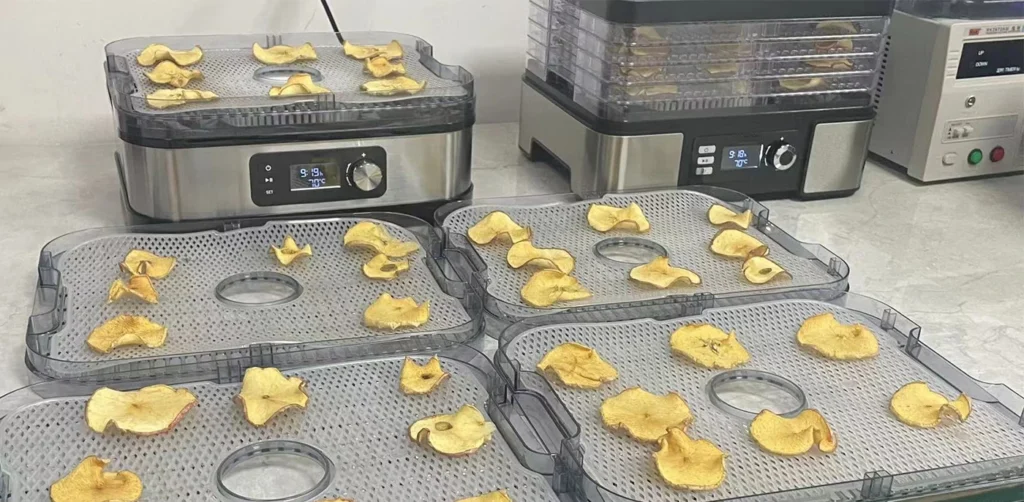
Furthermore, mesh or perforated trays are ideal for beef jerky dehydrator and smaller pieces.
Likewise, removable trays make loading, unloading, and cleaning much easier.
Material & Hygiene
Therefore, for home hygiene, prefer food-grade plastics rated for heat or stainless-steel interiors.
Also, smooth surfaces and detachable seals simplify cleaning after use.
Control System & Ease of Use
Moreover, digital timers and simple temperature dials are preferred in home kitchens.
Subsequently, pre-set programs for fruit, herbs, or jerky are a plus.
Energy Efficiency
In the long run, look for units with lower wattage per hour if you plan frequent use.
Consequently, an energy-efficient model saves money and is quieter.
Safety Features
Finally, pick units with automatic shutoff, overheating protection, and stable footings.
Choosing a Dehydrator for Jerky: Home Considerations
If you plan to make jerky at home, a dehydrator for jerky or beef jerky dehydrator should meet specific domestic needs. Accordingly, here are the key homeowner concerns.
Temperature Stability: For safe and tasty jerky at home, choose a unit with consistent heat and simple controls; tight industrial PID control is not essential for casual use.
Air Distribution: Moreover, ensure trays allow air under and above slices; top or rear airflow designs often work well in home models.
Tray Perforation: In addition, mesh trays are preferred so air flows freely around each slice, improving consistency.
Ease of Cleaning: Consequently, removable, dishwasher-safe trays reduce effort and help keep things sanitary.
Basic Endpoint Checks: Instead of lab moisture probes, home cooks can use a simple bend test and follow tested recipes to reach safe moisture levels.
Vacuum Sealer: Vacuum seal after drying for longer storage.
For safe home jerky: always marinate and pre-cook to recommended internal temperatures if your recipe requires it, then finish in the dehydrator. In short, small-batch trials help dial in time and texture without waste.
Buying & Home-Use Tips
For household buyers, convenience and reliability matter most. Therefore, follow these straightforward tips when choosing and using your unit.
Decide on Capacity: First, estimate how many trays you’ll use per session; small families may be fine with 3–5 trays.
Look for Simple Controls: Next, favor models with intuitive timers and temperature dials or a couple of presets.
Check Cleanability: Moreover, removable trays and smooth interiors save time; dishwasher-safe parts are ideal.
Safety & Storage: Consequently, choose a stable footprint and compact size for easy storage in a kitchen cabinet.
Energy Use: In addition, if you dry weekly, a mid-wattage model balances speed and cost.
Recipe & Testing: Finally, start with trusted home jerky recipes and run small batches to perfect texture and time.
Furthermore, keep a small notebook or digital log of times and thickness for your favorite recipes; this simple habit makes repeatable success easy.